Modern manufacturing facilities require more than efficient machinery and skilled workers. Maintaining clean and controlled air is also an important part of a safe, productive, and reliable manufacturing environment. Dust, airborne particles, contaminants, fumes, and other pollutants can affect workers, production processes, equipment, and the overall quality of manufactured products.
This is where air filtration solutions for manufacturing industries become important.
A properly designed industrial air filtration system can help control airborne particles, support cleaner working environments, protect sensitive equipment, and improve the performance of HVAC and ventilation systems.
Why Air Filtration Is Important in Manufacturing
Manufacturing facilities can generate different types of airborne contaminants depending on the production process. Dust from raw materials, fine particles from machining, packaging materials, chemical processes, and other industrial operations can enter the air.
Without appropriate filtration, these contaminants may circulate through the workplace or HVAC system.
An effective industrial air filtration system helps capture airborne particles before they can affect the surrounding environment.
The right filtration system can help manufacturing facilities with:
-
Cleaner indoor air
-
Better workplace conditions
-
Protection of machinery and equipment
-
Reduced airborne dust and particles
-
Improved HVAC performance
-
Better control of production environments
-
Support for product quality and hygiene requirements
Types of Air Filters Used in Manufacturing Industries
Different manufacturing environments have different filtration requirements. A single filter may not be suitable for every application.
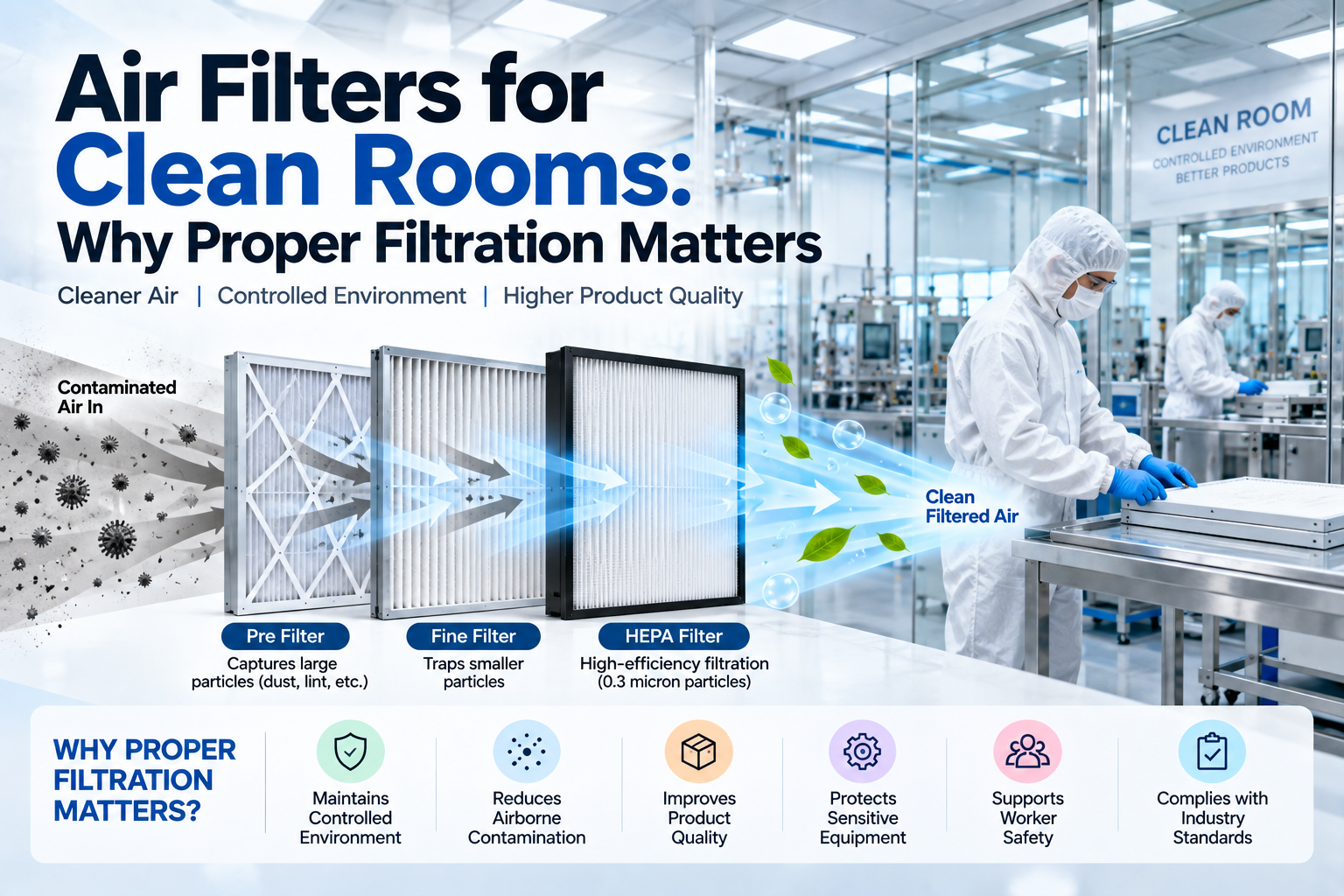
1. Pre Filters
Pre filters are generally used as the first stage of filtration.
They capture larger dust particles and contaminants before the air reaches finer filtration stages. This can help extend the service life of downstream filters.
Pre-filtration is particularly useful in systems where the incoming air contains higher levels of dust and larger particles.
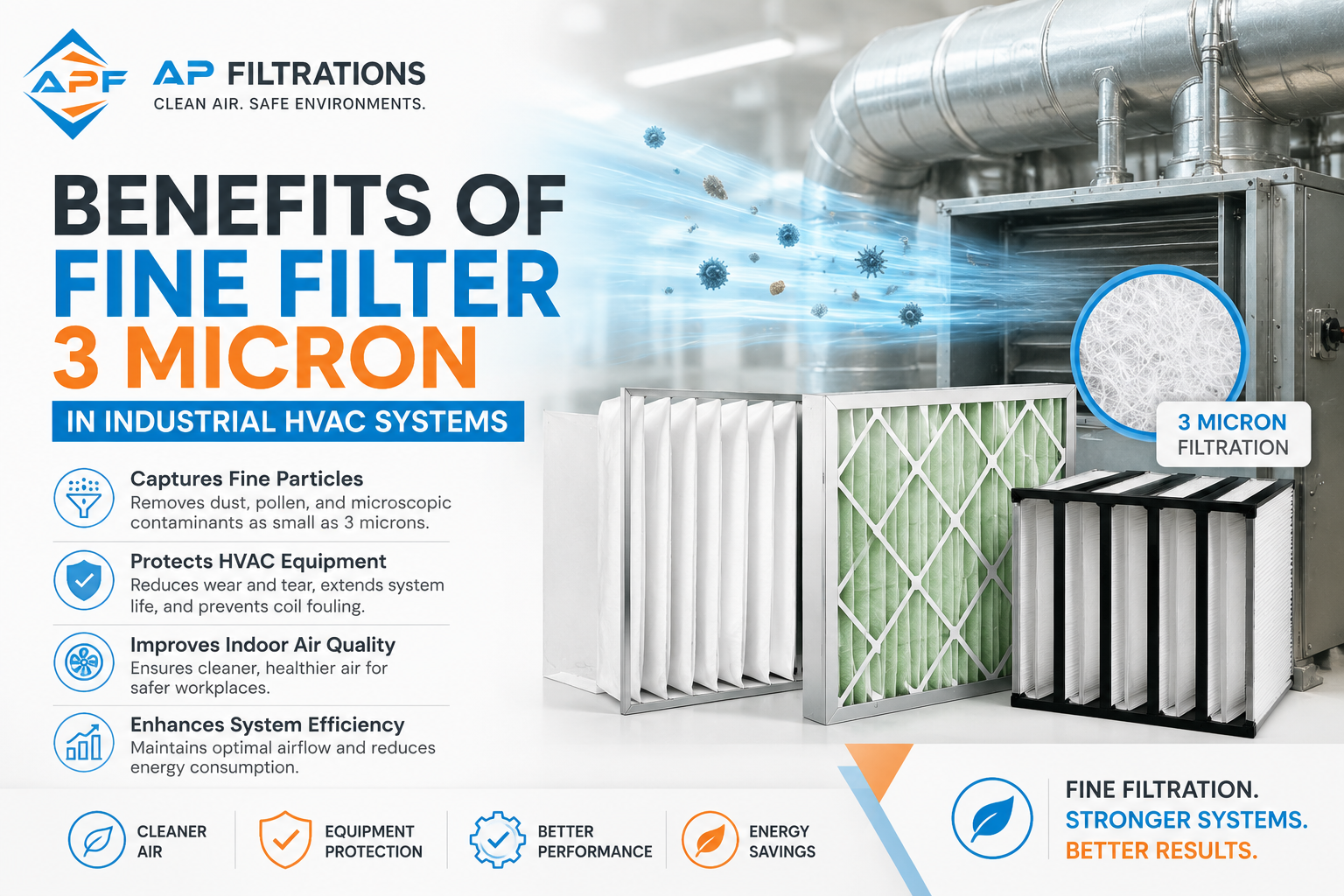
2. Fine Filters
Fine filters provide a higher level of particle filtration compared with basic pre-filters.
They are commonly used in HVAC and industrial air handling systems where improved air cleanliness is required.
Fine filters can act as an important intermediate stage before air passes through high-efficiency filtration.
3. HEPA Filters
HEPA filters are designed for high-efficiency removal of very fine airborne particles.
They are particularly relevant for applications where maintaining controlled and highly filtered air is important, including pharmaceutical manufacturing, healthcare environments, clean rooms, electronics manufacturing and other critical applications.
AP Filterations offers HEPA filtration solutions as part of its range of high-performance filtration products.
4. Custom Filtration Units
Manufacturing facilities can have different AHU configurations, airflow requirements, available installation spaces and operating conditions.
For this reason, customized filtration solutions can be useful when standard filter dimensions or configurations do not meet the requirements of a particular application.
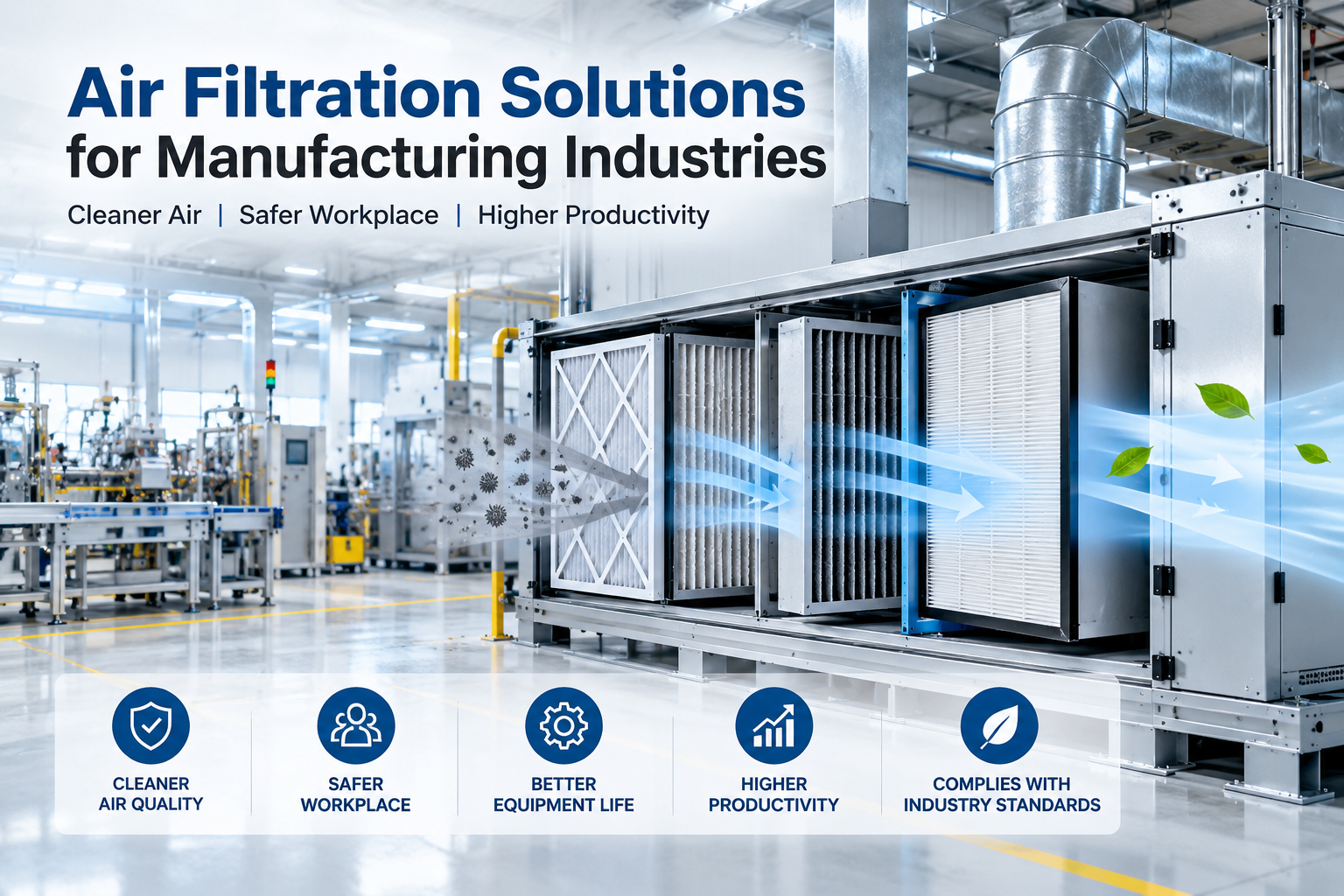
How a Multi-Stage Filtration System Works
Many industrial air filtration applications use multiple filtration stages rather than relying on one filter.
A typical filtration process may include:
Stage 1 – Pre-Filtration
Larger particles are captured first.
↓
Stage 2 – Fine Filtration
Smaller airborne particles are filtered through a finer filtration stage.
↓
Stage 3 – High-Efficiency Filtration
HEPA filtration can provide a high level of particle removal for applications requiring cleaner and more controlled air.
AP Filterations describes a systematic filtration process that includes pre-filtration, primary filtration, fine filtration and quality assurance.
Benefits of Industrial Air Filtration Systems
Cleaner Manufacturing Environment
Controlling airborne particles can help maintain a cleaner working environment, particularly in facilities where dust and airborne contamination can be generated during production.
Protection of Equipment
Dust and particles can accumulate on machinery, ventilation components and sensitive equipment.
Appropriate filtration can help reduce the amount of airborne contamination reaching these components.
Improved HVAC Performance
Air filters are an important part of HVAC and air-handling systems.
Using an appropriate filtration configuration can help support effective air treatment while maintaining the required airflow and pressure conditions.
Better Product Protection
Certain manufacturing processes require controlled environmental conditions.
Industries such as pharmaceuticals, food processing and electronics may require higher levels of air cleanliness depending on their processes and facility requirements.
Support for Workplace Safety
A cleaner indoor environment can contribute to better workplace conditions by helping control airborne dust and particulate matter.
However, filtration requirements should always be determined according to the specific contaminants, process conditions and applicable safety requirements.
Air Filtration Applications Across Manufacturing Industries
Air filtration systems can be used across many manufacturing sectors.
Pharmaceutical Manufacturing
Pharmaceutical production may require controlled environments and high-efficiency filtration systems. HEPA filtration can be used in applications where high levels of airborne particle control are required.
Food Processing
Food processing facilities may require filtration solutions to help maintain hygienic production environments and control airborne particles.
Electronics Manufacturing
Electronic components can be sensitive to dust and airborne contamination. Proper filtration can therefore be an important part of controlled manufacturing environments.
Automotive Manufacturing
Automotive plants involve various production processes that may generate dust, particles, fumes or other airborne contaminants. Filtration systems can be integrated into ventilation and HVAC applications based on the specific process.
General Manufacturing
General manufacturing facilities can also benefit from appropriately selected pre-filters, fine filters, HVAC filters and high-efficiency filtration systems.
How to Choose the Right Air Filtration System
Selecting an industrial air filter should not be based only on the filter size.
Several factors should be considered:
1. Airflow Requirement
Determine the required airflow of the HVAC or air-handling system.
2. Particle Type and Size
Identify the type of contaminants present in the manufacturing environment and their approximate particle characteristics.
3. Required Filtration Efficiency
Different applications require different filtration levels. A basic manufacturing area may have different requirements from a pharmaceutical clean room.
4. Pressure Drop
The pressure drop across a filter is an important consideration because it can affect airflow and HVAC energy requirements.
5. Filter Dimensions
The filter should be compatible with the existing AHU, HVAC system or filtration housing.
6. Maintenance Requirements
Consider how frequently filters need inspection, cleaning or replacement and how easily maintenance can be performed.
7. Operating Environment
Temperature, humidity, dust loading and other environmental conditions can affect filter selection and service life.
Why Choose a Specialized Air Filtration Manufacturer?
A specialized filtration manufacturer can help businesses select solutions according to their specific application rather than simply supplying a standard filter.
AP Filterations states that it provides filtration solutions for industrial, commercial and healthcare environments and offers custom-engineered solutions for different applications.
The company also lists manufacturing, pharmaceutical, healthcare, HVAC, food and electronics among the industries it serves.
Conclusion
Effective air filtration is an important component of modern manufacturing facilities. From pre-filters and fine filters to high-efficiency HEPA filtration, the correct combination depends on the facility, production process, airflow requirements and desired level of air cleanliness.
Investing in an appropriately designed industrial air filtration system can help manufacturing facilities maintain cleaner air, protect equipment, support production requirements and improve overall environmental control.
If you are looking for air filtration solutions for manufacturing industries, AP Filterations provides a range of filtration products and customized solutions for industrial and commercial applications.
Frequently Asked Questions
What is an industrial air filtration system?
An industrial air filtration system is designed to remove dust, particles and other airborne contaminants from air used or circulated within industrial facilities.
Which filters are used in manufacturing industries?
Depending on the application, manufacturing facilities may use pre-filters, panel filters, fine filters, HEPA filters and customized filtration units.
Are HEPA filters suitable for manufacturing facilities?
HEPA filters can be suitable for manufacturing applications that require high-efficiency particle filtration. Their suitability depends on the specific process and environmental requirements.
How do I choose the right industrial air filter?
Filter selection depends on airflow, filter dimensions, particle characteristics, required efficiency, pressure drop, operating conditions and maintenance requirements.
Does AP Filterations provide customized filters?
AP Filterations states that it provides custom-engineered filtration solutions and custom-sized filters for different applications.