Clean rooms are specially designed environments where airborne particles, contamination and environmental conditions need to be carefully controlled. They are widely used in industries such as pharmaceuticals, healthcare, biotechnology, electronics, food processing and other manufacturing applications.
One of the most important components of a clean room is its air filtration system.
Without proper filtration, airborne dust, particles and other contaminants can enter the controlled environment and potentially affect products, processes and equipment.
This is why selecting the right air filters for clean rooms is an important part of clean-room design and maintenance.
What Is a Clean Room?
A clean room is a controlled environment designed to maintain specific levels of airborne particles and other environmental conditions.
Depending on the application, a clean room may require control over:
-
Airborne particle concentration
-
Airflow
-
Temperature
-
Humidity
-
Air pressure
-
Contamination levels
The filtration system works together with the HVAC and air-handling system to maintain the required environmental conditions.
Why Is Air Filtration Important in Clean Rooms?
Ordinary HVAC filtration may not be sufficient for applications that require highly controlled air cleanliness.
Clean-room air filtration is designed to remove airborne particles before they enter or circulate within the controlled environment.
Proper filtration can help:
-
Reduce airborne contamination
-
Maintain cleaner working conditions
-
Protect sensitive products
-
Protect sensitive equipment
-
Support consistent manufacturing processes
-
Improve environmental control
-
Support applicable industry requirements
For industries where contamination can affect product quality, filtration becomes a critical part of the overall clean-room system.
What Types of Air Filters Are Used in Clean Rooms?
Different clean-room applications may use multiple stages of filtration.
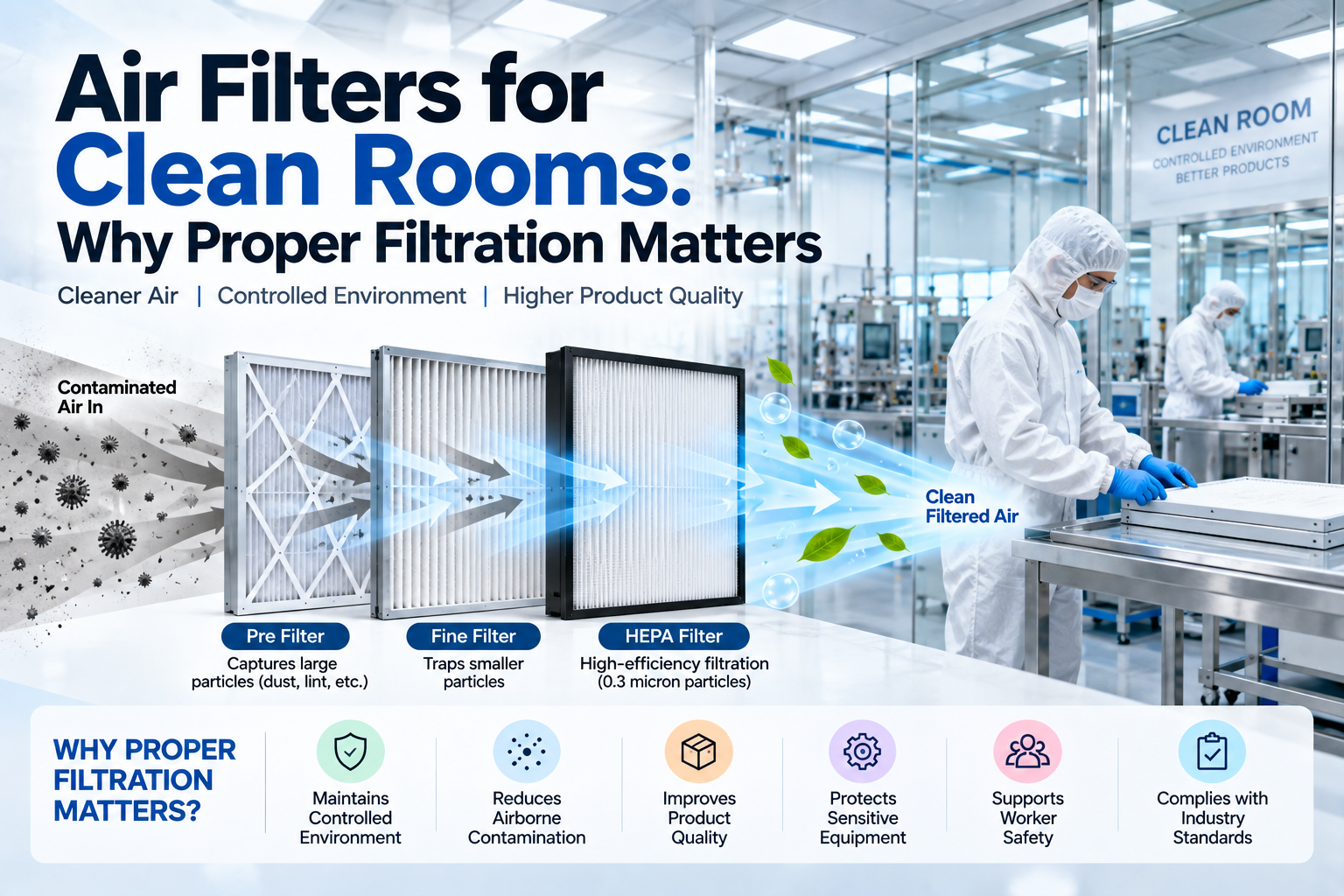
A common filtration arrangement can include:
Pre Filter → Fine Filter → HEPA Filter
Each stage has a specific purpose.
1. Pre Filters
Pre-filters are generally used as the first filtration stage.
They capture larger particles such as dust and other coarse contaminants before air reaches the finer filtration stages.
Using pre-filtration can help reduce the particle load on downstream filters.
2. Fine Filters
Fine filters provide a higher level of filtration than basic pre-filters.
They are commonly used as an intermediate filtration stage before high-efficiency filters.
Fine filtration can help reduce the load reaching the HEPA filter.
3. HEPA Filters
HEPA filters are widely used in applications where high-efficiency particle filtration is required.
They are particularly important in controlled environments such as pharmaceutical manufacturing, healthcare facilities, clean rooms and electronics manufacturing.
AP Filterations offers HEPA filtration solutions for applications requiring high-efficiency air filtration. (AP Filterations)
How Does Clean-Room Air Filtration Work?
A properly designed clean-room filtration system generally works through multiple stages.
Step 1: Air Enters the Filtration System
Air from outside or from the recirculation system enters the HVAC or air-handling unit.
Step 2: Pre-Filtration
The first filter captures larger particles and dust.
Step 3: Fine Filtration
The next filtration stage captures smaller airborne particles.
Step 4: HEPA Filtration
The HEPA filter provides high-efficiency filtration before air is supplied to the clean room.
Step 5: Clean Air Enters the Controlled Area
The filtered air is distributed through the clean-room ventilation system to help maintain the required environmental conditions.
The exact filtration arrangement depends on the clean-room classification, application and HVAC design.
Benefits of Proper Air Filters for Clean Rooms
1. Reduces Airborne Contamination
Dust and airborne particles can affect sensitive manufacturing processes.
High-efficiency filtration helps reduce the amount of particulate contamination entering the controlled environment.
2. Helps Protect Products
In industries such as pharmaceuticals and electronics, even small airborne particles can potentially affect sensitive products or processes.
Proper filtration can help maintain cleaner production conditions.
3. Supports Product Quality
Consistent environmental conditions can be important for maintaining production quality.
A properly maintained filtration system is one part of maintaining those conditions.
4. Protects Sensitive Equipment
Dust and particles can accumulate on sensitive machinery and components.
Effective air filtration can help reduce airborne contamination reaching equipment.
5. Supports Controlled Environments
Clean rooms depend on coordinated HVAC, filtration, airflow and environmental controls.
The correct filter configuration helps support the overall system.
Clean Room Air Filters for Pharmaceutical Manufacturing
Pharmaceutical manufacturing is one of the most important applications for controlled air filtration.
Manufacturing processes may require controlled environments to reduce contamination risks.
Depending on the application, pharmaceutical facilities may use:
-
Pre-filters
-
Fine filters
-
HEPA filters
-
High-efficiency air filtration systems
-
Air handling units
-
Terminal filtration systems
The exact filter specification should be selected according to the facility design, process requirements and applicable standards.
Clean Room Filters for Electronics Manufacturing
Electronics and semiconductor-related manufacturing can also require controlled environments.
Fine particles can potentially affect sensitive components and manufacturing processes.
For such applications, high-efficiency filtration can help maintain controlled air conditions and reduce airborne particulate contamination.
Clean Room Filtration for Healthcare
Hospitals, laboratories and healthcare facilities may also use high-efficiency filtration systems in areas where air cleanliness is particularly important.
The required filtration level depends on the specific room, application and facility design.
How to Select the Right Clean Room Air Filter
Choosing the right filter involves more than simply selecting a filter based on its physical size.
Important factors include:
Airflow Requirements
The filter must be suitable for the required airflow of the HVAC or air-handling system.
Filtration Efficiency
The required efficiency depends on the application and level of air cleanliness required.
Filter Dimensions
The filter should correctly fit the AHU, housing or terminal filtration system.
Pressure Drop
Pressure drop should be considered because excessive resistance can affect airflow and HVAC performance.
Operating Environment
Temperature, humidity, dust loading and other environmental conditions can affect filter performance and service life.
Maintenance Requirements
The facility should have a suitable inspection, testing and filter-replacement schedule.
Why Multi-Stage Filtration Is Important
Using multiple filtration stages can improve the overall filtration strategy.
For example:
Pre Filter
↓
Captures larger particles
Fine Filter
↓
Captures smaller particles
HEPA Filter
↓
Provides high-efficiency final filtration
This approach can also help protect the final HEPA filtration stage by reducing the amount of particulate matter reaching it.
How Often Should Clean Room Filters Be Replaced?
There is no universal replacement period for every clean room.
Filter service life depends on:
-
Air quality
-
Particle loading
-
Operating hours
-
Filter type
-
Pressure drop
-
HVAC airflow
-
Environmental conditions
-
Maintenance practices
Filters should therefore be inspected and monitored regularly.
Pressure-drop readings, visual inspection and system performance can help determine when replacement is required.
HEPA filters may have a considerably longer service life in clean environments compared with high-dust industrial environments, but replacement should always follow the application's requirements and the manufacturer's recommendations.
Importance of Proper Filter Maintenance
Even a high-quality filter may not perform correctly if it is improperly installed or maintained.
Maintenance teams should regularly check for:
-
Damaged filter media
-
Air leakage
-
Incorrect installation
-
Excessive dust loading
-
Moisture
-
Increasing pressure drop
-
Reduced airflow
Proper sealing is particularly important because air bypassing the filter can reduce the effectiveness of the filtration system.
Why Choose a Specialized Air Filtration Manufacturer?
Clean-room applications often have specific filtration requirements.
A specialized filtration manufacturer can help select or manufacture filters according to:
-
Required dimensions
-
Airflow
-
Filtration efficiency
-
Application
-
HVAC configuration
-
Environmental conditions
AP Filterations provides filtration products and customized filtration solutions for different industrial, commercial and healthcare applications. (AP Filterations)
The company's filtration solutions include applications related to manufacturing, pharmaceuticals, healthcare, HVAC, food and electronics. (AP Filterations)
Conclusion
Proper air filtration is one of the key components of a controlled clean-room environment.
From pre-filters and fine filters to high-efficiency HEPA filters, each filtration stage can play an important role in controlling airborne particles and supporting cleaner environmental conditions.
The right air filters for clean rooms should be selected according to the application's airflow, filtration requirements, environmental conditions, HVAC design and maintenance requirements.
For pharmaceutical manufacturing, electronics, healthcare, food processing and other controlled environments, a properly designed filtration system can help support product quality, equipment protection and cleaner working conditions.
AP Filterations provides air filtration solutions, HEPA filters, fine filters and customized filtration products for various industrial and commercial applications.
Frequently Asked Questions
What type of filter is used in a clean room?
Clean rooms can use multiple filtration stages, including pre-filters, fine filters and HEPA filters. The exact configuration depends on the application and clean-room design.
Are HEPA filters suitable for clean rooms?
Yes, HEPA filters are commonly used in clean-room applications where high-efficiency particle filtration is required.
Why are HEPA filters important in pharmaceutical clean rooms?
HEPA filters can provide high-efficiency filtration of airborne particles, helping controlled environments maintain the required level of air cleanliness.
How often should clean-room filters be replaced?
Replacement depends on filter type, particle loading, pressure drop, operating hours and environmental conditions. Filters should be monitored and replaced according to manufacturer recommendations and application requirements.
Can clean-room filters be customized?
Yes. Custom-sized and application-specific filtration solutions may be required depending on the HVAC system and clean-room configuration.
Which industries use clean-room filtration?
Clean-room filtration is commonly relevant to pharmaceutical manufacturing, healthcare, biotechnology, electronics, food processing and other industries requiring controlled environments.